Showing posts with label Ilam. Show all posts

Wednesday, 30 April 2014

The fugitive priest 1581


I came across a reference in a history of Catholicism in Staffordshire to a clandestine visit made by St Edmund Campion to Throwley Hall near Ilam in January 1581.  The Old Hall is a picturesque ruin set in the beautiful Peak District, but once it was a home to the Meverall family who were keen to maintain their Catholicism. The terrible pressures that many believers especially priests like Campion faced in maintaining their faith is a cruelly overlooked aspect of history. Campion’s story is a vivid commentary on this persecution. He first came to prominence while a student at Oxford. He was considered one of the most brilliant scholars of his generation chosen to deliver a homily in Latin in praise of Elizabeth 1st to a delighted queen when she visited the University in 1570. In the decade that followed he converted to Catholicism, trained as a priest and undertook a dangerous mission to England to give support to the Catholic community.

It was a perilous time to be a priest. By the end of the 16th century in a time of Protestant Ascendancy life for Catholics was becoming increasingly difficult. The Elizabethan establishment feared them. England was threatened by a militant Catholic Spain, in France at the St Bartholomew Massacre of 1572 scores of Protestants were slaughtered in the streets of Paris, the Pope urged Catholics to kill Elizabeth and a number of attempts were made on her life. Under the circumstances repressive measures were passed making it an offence punishable by death to persuade people to join the Church. The State issued fines and seized the property of Catholics who did not attend Church of England services drawing up lists of believers on a county by county basis. In 1590 in Staffordshire listed Catholics included Richard Biddulph of Biddulph, Thomas Cotton of Grindon,William Whadyere and Margaret Grey of Cheddleton and Elizabeth Beardsley of Draycott who received  sanctions. Investigators appointed by the Government were sent in to root out priests and their supporters. Among them perhaps the most loathsome man in English history Richard Topcliffe  torturer, sadist, rapist and MP. He regarded Staffordshire as a “backwood” and he clashed with William Basset of Blore fellow MP and Sheriff of Staffordshire who was a secret Catholic. Bassett may have been aware of the visit of Campion in January 1581 who toured Derbyshire, Staffordshire and Lancashire preaching to the faithful. The priest was eventually caught, interrogated and led through the street of London wearing a sign “ Campion, seducer of the people” before being publicly eviscerated. He was canonised by Pope Paul in 1970 along with Ralph Sherwin of Derbyshire, who I might be distantly related to through my Mothers Sherwin family.


Commentators have cited the similarities between the treatment of Catholics in the 16th century and Muslims now. Both were regarded with suspicion, both beliefs have been regarded as “outlandish” and agents of foreign powers. A few Catholics during the 16th century carried out attacks against the State as have a few Muslims now. Some Catholics were seized and tortured and some Muslims have been the victim of “extraordinary rendition” removed and tortured with the knowledge of the British Government. But  most 16th century Catholics wanted to live their lives peaceably with their neighbours as do most Muslims today. It took Catholics 200 years to achieve full civil rights in Britain.

Thursday, 6 February 2014

Youth Hostels


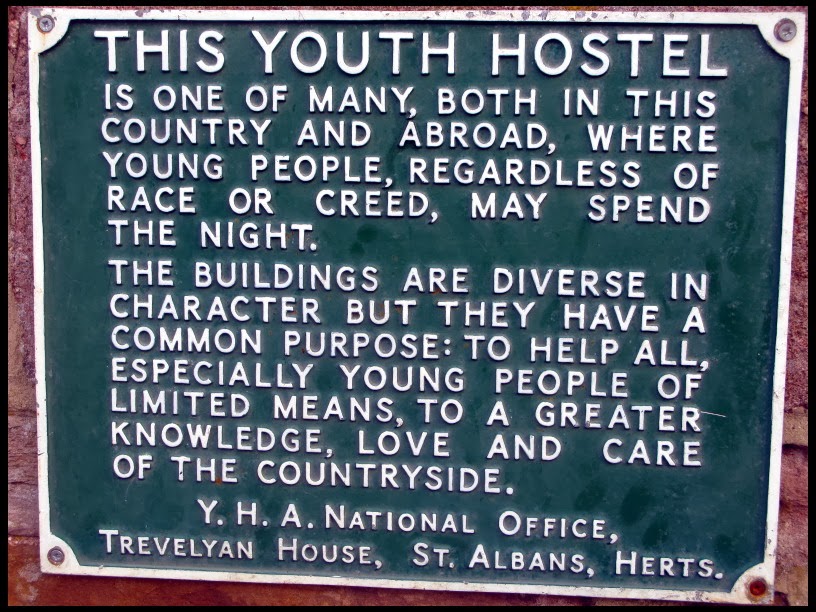
My family rejoined the Youth Hostel Association last summer. I have been a member for many years and visited dozens of hostels around the country. The Moorlands used to have several hostels although their numbers have been depleted and reduced even further with the selling off of Gradbach Hostel last year to Newcastle College.

The movement in the UK was born 80 years ago when cheap accommodation was opened in scenic parts of the country giving young people from industrial areas their first opportunity to explore the picturesque beauties of the UK. It gained royal approval early on when the Prince of Wales opened Derwent Hall in the Peak District in 1932.

Ilam Hostel opened in 1935 fulfilling a need as the Peak District attracted 20,000 youth hostellers to existing hostels in the area. During the war Ilam was pressed into service providing emergency accommodation for Czech refugees. Other hostels that opened in the 1930s were Ashover and Rudyard, both of which have long since closed. Rudyard had a distinguished literary visitor in the winter of 1936. George Orwell used it en route to Wigan to research “Road to Wigan Pier”; Orwell stayed a night at the Youth Hostel beside the Lake. It was intensely cold the hostel was unheated and lit only by candles. He had to thaw out over a fire in the morning. The lake was frozen and ice had formed into blocks which made a clanking sound as they collided. Cigarette packets bobbed up and down among the ice floes. Orwell thought it was a very depressing place.

YHA membership took off after the war with over 300 hostels opened by 1950 with individual membership reaching 200,000.

The first hostel I used was Hartington which coincidentally was the hostel where I rejoined in August. It was the summer of 1970 and I was part of a geography field trip from school. Of the local ones I have also stayed at Meerbrook in the late 80s which was rather cold and damp and Ilam which was delightful. I used to prefer the simpler hostels such as Ellingstring in Yorkshire Wheathill in Shropshire and Alpheton in Suffolk which was an old Nissen hut. It is a pity that these hostels were those targeted for closure in the 1990s as I found them basic but charming.


Anyone who has stayed any time in hostels during the old regime would be familiar with the “chores” that hostellers would be given and also the often eccentric hostel wardens who ruled with an iron fist and dole out the duties. I fell foul of such a character in the 80s at a basic hostel on Dartmoor who took a dim view of anyone who went to the pub. Dressed in lederhosen stretched over a portly frame the very camp warden admonished me in a phrase that has always lived with me “I tend to find that my young gentlemen like to go to bed early after a hard day on the hills”. I was on toilet cleaning duties the following day.

Sunday, 26 January 2014

Battle of the Nile

The sad  news that the closure of the Portsmouth Dockyards will end 500 years of naval ship building coincides as  a major exhibition on Admiral Lord Nelson opens at the Royal Maritime Museum at Greenwich. The exhibition presents the legendary deeds of  Britain’s greatest and most charismatic  military leader.

Horatio Nelson achieved national prominence firstly with his daring exploits during the Battle of St Vincent in 1797 when the Royal Navy squadron was under the command of Admiral John Jervis of Meaford near Stone(  Given that the county is land locked, Staffordshire has produced great naval officers of the stature of Jervis, Anson and Gardner). But Nelson’s international fame was firmly cemented at the Battle of the Nile of August 1798 when he led the fleet against a larger French force supporting Napoleon’s invasion of Egypt. Showing audacious leadership his fleet annihilated the French culminating in the flagship, L’Orient   exploding killing the French commander Brueys and all but one hundred of the ship’s crew.

The immediate result of the battle was the collapse of Napoleon’s invasion of Egypt and the lifting of any threat to Britain’s control of India. Napoleon abandoned his army to its fate and returned to France.

 The battle cost Nelson 218 killed and 677 wounded, while the French suffered around 1,700 killed, 600 wounded, and 3,000 captured. During the battle, Nelson was wounded in the forehead, exposing his skull. Despite bleeding profusely, he refused preferential treatment and insisted on waiting his turn while other wounded sailors were treated before him.

News of the victory reached Staffordshire in November where the news was greeted euphorically in Cheadle.

The Staffordshire Advertiser reported of “the rising spirit and the glowing ardour of this little but loyal town, a procession of many hundreds of the inhabitants carrying lighted torches and emblematic devices of victory marched through Cheadle escorting the post”. The crowd enjoyed a roasted sheep washed down by large amounts of “stout old October” finishing the hilarity of this festive evening”.

Elsewhere the crushing victory was celebrated on the highest hills of the district. On top of Thorpe Cloud on the 29th November 1798 a sheep was roasted and a large bonfire lit, “a considerable quantity of ale was given by Hugh Bateman of Ilam to above 100 persons assembled there from neighbouring villages terminating the thanksgiving of the day on the summit by repeated toasts to the health of Lord Nelson and to the continued success of His Majesty’s arms”.

Wonderfully, the “Advertiser” ended its report with the words “it is the transcendent glory of this island alone, to shine with the lustre of a superior planet amidst the dim horizon of political darkness”


Now, as then, the Royal Navy has a special place in the hearts of this island nation. 

Wednesday, 27 March 2013

St Bertram of Ilam


It took 100 years for Christianity to establish itself in England after Augustine landed in Kent in 597. It seems that missionaries mixed pragmatically piety with an ability to “schmooze” the local rulers as they fanned out around the country. Bishop Wilfrid of York, in one example ,held a three day drunken revelry with many of the nobility of Northumbria and Mercia to celebrate the dedication of Ripon Cathedral in the 660s. Proselytising in those days came with a hangover it would seem. It was a crucial time for the establishment of the Church and it was around this time that Christianity arrived in Staffordshire. It is difficult however to disentangle the myth and reality in the lives of the local Saints. I was pondering on this whilst visiting the shrine to St Bertram or Bertellinus at Ilam Church.

Bertram, so the story goes, was of royal blood and having fallen out with his father fled to Ireland where he fell in love with a princess. She became pregnant and they escaped to England sheltering in the dense forests that surrounded Ilam in the 7th century. Alexander a monk writing in the 13th century takes up the story.

They were in hiding in a dense forest when lo ! the time
of her childbirth came upon them suddenly ; born of pain and
river of sorrow ! A pitiful child bed indeed ! While Bertellinus
went out to get the necessary help of a midwife the woman and
her child breathed their last amid the fangs of wolves. Bertellinus
on his return imagined that this calamity had befallen because
of his own sin, and spent three days in mourning rites”.

That was the turning point in his life, he retired from the world and became a hermit. Bertram is linked with Stafford where he preached converting the heathen. Then he returned living in one of the caves beside the river Dove. After his death his remains were buried at Ilam,

The shrine itself is in the Lady Chapel. It is in the form of an altar tomb made about 1386 when a blind Ilam man, named Wilmot prayed to Bertram and recovered his sight. People still leave requests for prayers on the shrine. When I was there prayers of intercession among them people who had lost their faith, a sick relative and for a woman who had committed suicide from Birmingham were placed on the shrine.

Wednesday, 6 March 2013

Do you remember March 1970?


1970 saw the passage of the equal pay act a major step in women's rights . The legislation was the result of the pressure applied to the Labour Government by actions such as the strike at Ford's Motor Company over equal pay- the subject of the film “Made in Dagenham . Job adverts of the time are a good place to start looking at the obstacles that females faced in the workplace. In Leek women with families were encouraged to apply for the “Housewives Shift” , an innovation in employment practices, at Weston Street Mill. Female typists were required for Thomas Boltons at Froghall and at Gush and Dent a “keen young lady” was needed. The evidence that men and women were paid differently was apparent. In March a report of the Association of Manufacturers and Dyers published their minimum pay rates for a 40 hour week, for Men the rate was £14 and for women £11. It should be said that local Trade Unions were not overtly concerned in closing the gap as they tended to be male dominated


An unspoken social problem was domestic violence and the 70s saw it for the first time being debated openly. During March 1970 the local paper reported two cases in Leek and Cheadle. One of the incidents was described as a “domestic tiff” The book “ Scream Quietly or the neighbours would hear” was published in the decade. Erin Pizzey detailed her experiences of establishing a woman’s refuge in West London. (Her belief that the problem of violence against women was widespread is born out of my own experiences in Stoke. As a child I once see a woman attacked in the street.}  As she wrote in the introduction to her book “ as long as the myth of the Princess and the frog continues then young women will believe that a good woman can save any man and the ugly frog will turn into a Prince”.

Language was an important weapon in objectifying women. Young women attending a weekend Duke of Edinburgh course were referred to as “Dollies”. The Dollies in question -28 young women- spent a weekend at Ilam Youth Hostel taking courses on make up, cake decoration and fashion. Even in well meaning examples, the words used can be jarring to the modern ear. The principal of Leek College congratulated Leek woman Catherine Turner who had been selected to visit the USSR and study education methods going on to say that “she was part of a memorable band of housewives who had pioneered day classes for GCE exams”.

Domesticity was a quality prized and it was a attribute nurtured across the area by Women's Institutes- at the height of their popularity- where there was a perceived need to pass on housewifery skills across the generations. The WI had branches in most communities. In Rushton they had a talk on the new decimal coverage starting up the following February. Greenaway Moor were shown a film of Max Bygraves promoting Dutch Cheese, Tean a session on cake making. Mothers Union added to the sense as they pledged to perform their duties “they owe their husband, their children and their God”. At schools girls were taught domestic science concentrating on home making reinforcing the traditional role of women

Leek Ladies Hockey team were going from strength to strength in the early spring of 1970. After defeating Newcastle they had become the undisputed champions of the county. In this victory they had relied on three goals from Patsy Allen centre forward, The reporter was of the opinion that they had won because, “they had greater fire power up front and they commanded the centre of the field with the authority of an all conquering army”

Ali Barba's Club in Milton were running regular strip shows on a Tuesday alternating with a stag comedian. One can presume it was not a very sophisticated night out and little prospect of the “Second Sex” or “Female Eunuch” being discussed