Showing posts with label Soviet Union. Show all posts

Wednesday, 25 September 2013

Why Rudyard's war memorial has 1921 as the end of First World War


It has always occurred to me as odd that the war memorial in Rudyard should have the date August 31st 1921 as the date signifying the end of the First World War. Why should this be so? Most people, if asked, would automatically pick November 11th 1918 as the end of the War. Perhaps others might suggest June 1919 when the Treaty of Versailles between the belligerent powers was signed in the Hall of Mirrors. But again this seems not to be the case. The facetious side of me thinks that no one bothered to tell the people of Rudyard that the war was over. There is a precedent for official oversight as the people of Berwick on Tweed were left out of the peace treaty concluded between Britain and Russia in 1855 at the end of the Crimean War- Berwick was always included as a separate entity as it was a disputed border town between England and Scotland.

 There is also a Laurel and Hardy film “Blockheads” when Stan is asked to defend a trench. The Armistice is declared and Mr Laurel is overlooked and stays on the Western Front. Years later he is found, a huge pile of empty bean cans behind him and a furrow that Stan has ploughed constantly marching up and down are evidence of his steadfastness.

More seriously, I wondered if the continuing fighting in Soviet Union and in Ireland might offer a clue. After 1918 the Allies came to the assistance of the “White” pro Czarist forces who were fighting the Communist Government that had seized power the year previously. About 40,000 British troops were sent to the Soviet Union. The 7th Battalion of the North Staffordshire Regiment, my grandfathers unit, were sent to the oil fields of Baku in the Caucasus to fight with Armenians against the Soviets. I did know an old comrade of my grandfather Bill Daniels who took part in the campaign which ended in 1920. The other possibility is the Irish War of Independence involving British troops which at the time was at a crucial stage.  In 1921 a truce was being negotiated between the IRA and the British Government. However this does not seem to enter into the Rudyard case.


The answer lies in a report made in the official Government mouth piece British Gazette of the 12th August 1921 which announced the official end of the First World War following the signing of a peace treaty with Hungary. As part of the old Austro Hungarian Empire it was an element of the alliance that Britain went to war with in 1914. Therefore agreement with the Hungarians over territory and reparations triggered the official ending of the war and the rather pedantic date carved into the war memorial in Rudyard.

Wednesday, 30 January 2013

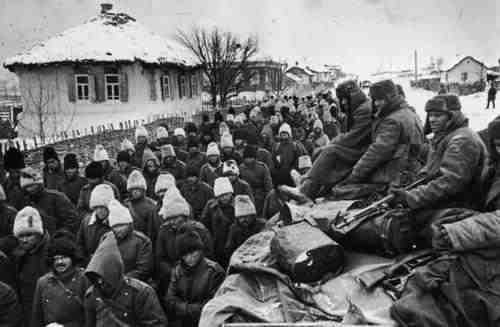
Stalingrad 1943


I was in a local school looking at a wall chart produced by pupils on the key events of the Second World War. Emphasis was rightly given to the Battle of Britain and D-Day, but no mention was made of the war in Eastern Europe. It’s the 70th anniversary of the titanic struggle at Stalingrad perhaps the most decisive battle of the war- an anniversary that has hardly been mentioned in the British media. This struggle in which the Nazis and their allies fought the Soviet Union for control of the city named for the Russian dictator was one of the bloodiest in the history of warfare with estimated 2 million casualties. The 6-month campaign, which climaxed in January 1943, inflicted catastrophic losses on the Third Reich from which it never recovered.

From June 1941 the Soviet Union was an ally of Britain. In Leek, as elsewhere in the UK, awareness of the struggle showed itself in the setting up of an Anglo Soviet Friendship Committee meeting at the Town Hall in December 1941. It was part of a co-ordinated response. The Committee busied itself by running fund raising events including a Soviet Medical Aid Fund in the New Year of 1942. Over the duration of the war meetings with speakers and events were held to recognise the super human efforts of our Soviet allies. Over two nights for instance, at Cheddleton Hospital in November 1942 a Russian ballet corps gave a concert.

Perhaps given the continuing interest in the war it is right to emphasis the fact that the Second World War was principally fought in Eastern Europe. It has been estimated that 80% of all German allied personnel died or went missing in action on the Eastern Front

The vast majority of German divisions were concentrated against the Soviet Union - in 1942, for instance, there were 240 fighting in the East and 15 in North Africa and even in 1944 there were more than 200 in the East compared to 50 divisions in the West. The two pivotal battles, Stalingrad and El Alamein, differed in scale by a factor of about ten, or an order of magnitude.

Over 36 million people 19 million of them civilians, died in Europe in this conflict. The real tragedy was that in Eastern Europe one tyranny was replaced with another 

Wednesday, 17 October 2012

October 1962- Cuban Missile Crisis recalled


We are coming up to the 50th anniversary of a time, which was nearly the end for humanity in October 1962. It was the occasion that the Soviet Union and the United States almost went to war over the siting of Soviet missiles on Cuba the Caribbean island off the coast of Florida. President Kennedy issued a series of ultimatums to Soviet President Kruschev demanding that the missiles, which could easily reach cities on the eastern seaboard of the United States, be removed. The US Navy began a naval blockade of the island with the tacit threat of firing on any Soviet ships. October 24th was the peak of the crisis. The Soviets relented and the possibility of a nuclear war passed. It was a close thing

I was 7 at the time. I can dimly recall the tense atmosphere of the time when the threat of nuclear war was a real possibility. A physical reminder of those nervous times was evident just across the road from where I lived. Somebody had painted on a war close to Stoke Railway station in large letters the slogan NO WAR OVER CUBA. The graffiti was so discernible that it stayed there for many years.

However reading the newspapers of the time there is no evidence that fear gripped the populace although it is likely that fears were deliberately surpressed by a Government keen not to panic the general public. The burning question for example that animated the parish councillors of Tean as the real prospect of atomic Armageddon approached was the fear that local couples were making out in a local telephone box. A Horton farmer Mr Bailey had photographed an odd shaped vegetable- a potato that looked like a rabbit. A letter from Rushton WI warned of the dangers of fireworks

However after the event passed realisation dawned that we had a narrow escape did dawn on some

The possibility of a nuclear holocaust remained a real one during the period of the Cold War- we again claim close in November 1973 when President Nixon put US forces on a high state of alert. And with the appalling availability of fissionable material possible falling into the hands of terrorists arguably the terrible prospect continues to haunt humanity.