
Wednesday, 19 February 2014


Wednesday, 12 February 2014
An abduction in the Peak District

We live in an age where the thought
of forced marriages and abductions fills people with horror and reports of such
events in the British Asian communities are condemned. Each year according to a
recent TV documentary over 10,000 young Muslim women are forced into such
arrangements against their will.
The picturesque Blore near Ilam seems a world
away from such considerations although a dramatic episode involving a forced
marriage took place at Blore Hall at the beginning of the 16th
century.
Margaret Kebell was the daughter of
Ralph Bassett and in 1502 was a newly widowed 25 years old. She had married 10
years before to an elderly Leicestershire lawyer on whose death the previous
year had left his young bride a sizable inheritance. In short, Margaret was now
a very attractive proposition to the gentry of the area as any wealth that she
had would become the property of the husband.
At the end of January Margaret
became engaged to Ralph Egerton of Wrinehill who was also a wealthy person as
he stood to inherit lands in Cheshire ,
A party was organised to celebrate the event. However someone had other ideas.
On the 1st February 1502
an armed band led by Roger Vernon of Wirksworth, Derbyshire assisted by a local
landowner Thomas Foljambe of Throwley Hall attacked Blore Hall. The brigands
arrived at 6am. The band was about 100 strong and was well armed. The trembling
guests and retainers were under siege by a group of determined men. Vernon ’s band broke in
and threatened the servants of Margaret Kebell brandishing swords to get them
to reveal her presence. Margaret was found and forced onto a horse and the
posse plunged over the River Dove back into Derbyshire. Quickly a compliant priest
was found in Derby
and the couple was married despite Margaret’s protests.
Margaret’s father was furious and
sent out parties to rescue his daughter. Roger Vernon was aware of the threat
and moved his new unwilling bride into Herefordshire until things quietened
down. Margaret’s
mother, Eleanor, accompanied by Eleanor's father and brother, set off in
pursuit of the abductors. They were outnumbered and unable to rescue Margaret,
but Margaret later managed to escape on her own and reach safety in London . Sir Henry Vernon
of Haddon Hall, Margaret’s father in law, was protesting his son’s innocence at
court to anyone who would hear that his daughter in law was just being
difficult. But Margaret was determined to have her say and gained personal
audience with Henry VII. The case ended up before the court of the Star
Chamber, where changes and counter-charges kept the litigation active for many
years. Vernon was
fined, but in December 1509 all those involved in the abduction were pardoned
by the new king Henry VIII. Margaret did eventually marry Ralph Egerton,
who was knighted in 1515. However whether it was a happy marriage is debateable
as Egerton was reputed to have fathered many illegitimate children.
Thursday, 6 February 2014
Youth Hostels
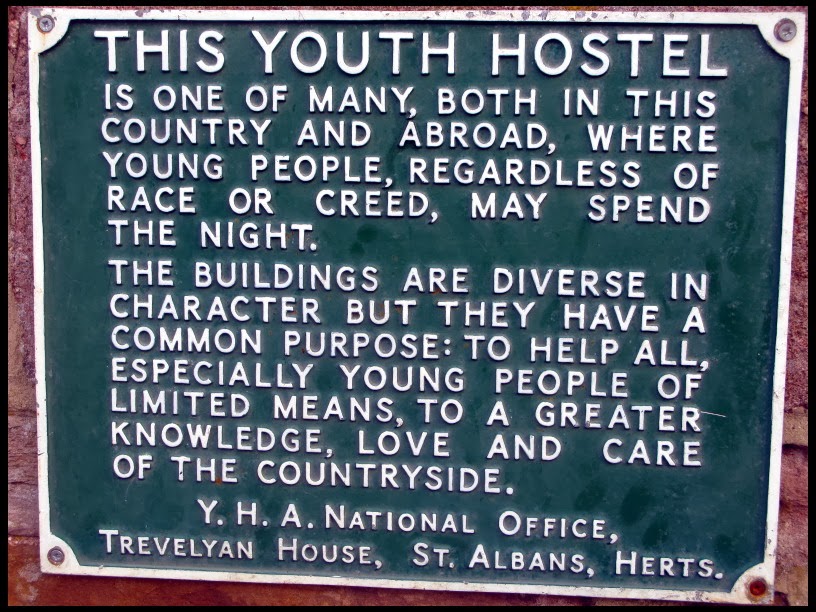
My family rejoined the Youth Hostel
Association last summer. I have been a member for many years and visited dozens
of hostels around the country. The Moorlands used to have several hostels
although their numbers have been depleted and reduced even further with the
selling off of Gradbach Hostel last year to Newcastle College
The movement in the UK was born 80 years ago when cheap
accommodation was opened in scenic parts of the country giving young people
from industrial areas their first opportunity to explore the picturesque beauties
of the UK .
It gained royal approval early on when the Prince of Wales opened Derwent Hall
in the Peak District in 1932.
Ilam Hostel opened in 1935
fulfilling a need as the Peak District attracted 20,000 youth hostellers to
existing hostels in the area. During the war Ilam was pressed into service
providing emergency accommodation for Czech refugees. Other hostels that opened
in the 1930s were Ashover and Rudyard, both of which have long since closed.
Rudyard had a distinguished literary visitor in the winter of 1936. George
Orwell used it en route to Wigan to research “Road to Wigan Pier”; Orwell
stayed a night at the Youth Hostel beside the Lake .
It was intensely cold the hostel was unheated and lit only by candles. He had
to thaw out over a fire in the morning. The lake was frozen and ice had formed
into blocks which made a clanking sound as they collided. Cigarette packets
bobbed up and down among the ice floes. Orwell thought it was a very depressing
place.
YHA membership took off after the
war with over 300 hostels opened by 1950 with individual membership reaching
200,000.
The first hostel I used was
Hartington which coincidentally was the hostel where I rejoined in August. It
was the summer of 1970 and I was part of a geography field trip from school. Of
the local ones I have also stayed at Meerbrook in the late 80s which was rather
cold and damp and Ilam which was delightful. I used to prefer the simpler
hostels such as Ellingstring in Yorkshire Wheathill in Shropshire and Alpheton
in Suffolk
which was an old Nissen hut. It is a pity that these hostels were those
targeted for closure in the 1990s as I found them basic but charming.
Anyone who has stayed any time in
hostels during the old regime would be familiar with the “chores” that
hostellers would be given and also the often eccentric hostel wardens who ruled
with an iron fist and dole out the duties. I fell foul of such a character in
the 80s at a basic hostel on Dartmoor who took
a dim view of anyone who went to the pub. Dressed in lederhosen stretched over
a portly frame the very camp warden admonished me in a phrase that has always
lived with me “I tend to find that my young gentlemen like to go to bed early
after a hard day on the hills”. I was on toilet cleaning duties the following
day.
The Raven

Some weeks ago I was walking down Burton Street on
the way to work when I heard a commotion before my head. I looked up and I saw
two Crows mobbing a Buzzard who was flying nonchalantly off unconcerned at the
antics of the member of the Corvus family.
It’s another member of that family
I wish to write about following a conversation with a fellow “twitcher” at the
Dimmingsdale reserve near Cheadle who was telling me of the increased presence
of the Raven, after a period of long decline.
WH Hudson the travel writer and
nature writer remarked in his 1913 book
“Adventures Among Birds” that on Axe Edge that the birds absence was marked "Not
a buzzard, not a harrier, not a raven which when soaring would seem an
appropriate object and part of the scenery in these high wild
places". The situation seems to have been turned around.
The largest member of the Crow family ravens
are very intelligent birds. Two wild ravens helped a captive one escape by
digging a hole from outside of its cage while the one inside dug from there.
They can be taught to talk. Ravens are playful and have learned to use tools.
They employ stones and other hard objects to crack nuts. It has been observed (not infrequently) that when a
member of the flock perishes, the birds will hold what could be called a “raven
funeral” – a 24-hour event marked by raucous outcries.
Its reputation in legend is not the
most cheerful one as it’s associated with death. Not surprising as it was a
bird that frequented the gallows of hanged men, a feeder off carrion and its
size, colour and dismal call add to the sepulchral image.
It has an association with pagan
deities such as Odin, Lugas the Celtic God and Bran the Blessed (Bran means
raven in Welsh) whose head is buried under the Tower of London
Ravens were considered messengers
of the Gods. One raven does appear in Bede’s Ecclesiastical History of the
English when St Paulinus is trying to preach in Yorkshire .
The croaking of a raven appeared to be competing with Paulinus and the people
think that the pagan Gods are arguing with Paulinus. (The Norse god Odin had
two raven familiars named Huginn and Muninn who perched on his shoulders and
told him everything they saw and heard)
I visited Durham Cathedral over the
summer in which the head of St Oswald who bought Christianity to the north of England is
buried in the same coffin as St Cuthbert. Oswald was killed at the Battle of
Maserfield in 642 near to modern day Oswestry (Oswald’s tree) fighting the
heathen Welsh and the Mercians. Although he was a Christian warrior Oswald
included the powerful symbol of the raven on his war banners. It may well be he
was keeping all options open in terms of his relationship with the pagan God
Odin least things did not work out in the other world.
Sunday, 26 January 2014
National Holocaust Memorial Day- the fate of Ruth Schmerler

The theme of Holocaust Memorial Day
on January 27th year will be “Journeys”. The Memorial Day originated in 2001
with the aim of remembering the crimes, racism and victimisation committed
during the Holocaust are neither forgotten nor repeated, whether in Europe or elsewhere in the world. It has been
commemorated every year since.
The young woman whose picture that
looks out at the reader is Ruth Schmerler whose journey began when she left her
home in Poland as a 14 year
old in 1939 moved to a home in Manchester
for Jewish Refugee Children with her brother Klaus. Her family had lived for
generations in Galicia in Poland . Ruth
worked as a Land Girl picking fruit in Worcestershire. She was found murdered
her body found at Counslow in late September 1944 on the Alton-Cheadle road. She
was 20 years of age, her journey had ended.
She was last seen receiving a lift
from an Army vehicle at Selly Oak in Birmingham
on 21st September. She was intending to see her brother in Manchester who was
working as an optician’s assistant. When her body was discovered she had been
stabbed as well as an attempt made to strangle her. Her clothes were
disarranged and a stocking was missing. Robbery was not thought to be a motive.
Ruth’s suitcase and other belongings were found 150 miles away at Shap Fell in Cumbria . Her
murder was unsolved despite the best efforts of the Cheadle police. It was the
first case that mine detectors were used in a vain attempt to find the weapon
that killed Ruth.
Ruth’s story is a poignant one. She
escaped the persecution of the Nazis who had killed all her relatives in Poland ,
for her to die brutally and her body to be thrown into a Staffordshire ditch.
Her story is just one of the many millions of people who were forced from
homelands where communities had lived for hundreds of years to be either killed
or resettled distances away from their birthplace. The Jewish community of
Eastern Europe ceased to exist and cities which had sizable minorities such as Prague , Warsaw and Lvov were entirely purged.
Only 150,000 Polish Jews survived out of a population of over 3 million by 1945.
After the war vast movements of populations occurred. Tony Judt in his seminal
book on Europe “ Postwar” estimated that over 30 million people were
dispossessed from 1939 to 1950 including 11 million Germans, millions in the
Soviet Union such as the Crimea Tartars thought to be enemies of the state,
Poles, Hungarians, Italians and many other groups in a massive attempt at
“homogenising” vast swathes of the continent. Many Jews moved to the new state
of Israel , but also to
unbelievably escape further persecution in Eastern Europe
. Some of the displaced people of Europe found homes in England as the
Polish community at Blackshaw Moor testifies.
Writing about a massacre of Jews
that took place in Stryl in Galicia
in the summer of 1943 Schaje Schmerler concluded with this prayer. “Their
extinguished souls that ascended to heaven and were transformed into stars
shine now together will the souls of all those unlucky Jews martyred-- al
kiddush hashem --they shine down on us lest we forget what was done to our
people”.
Ruth Schmerler lies in a Jewish
cemetery in Manchester .
Perhaps some passer-by can say Kaddish for her and her people?
Battle of the Nile

The sad news that the closure of the Portsmouth
Dockyards will end 500 years of naval ship building coincides as a major exhibition on Admiral Lord Nelson
opens at the Royal Maritime Museum
at Greenwich .
The exhibition presents the legendary deeds of Britain ’s greatest and most
charismatic military leader.
Horatio Nelson achieved national
prominence firstly with his daring exploits during the Battle of St Vincent in
1797 when the Royal Navy squadron was under the command of Admiral John Jervis
of Meaford near Stone( Given that the
county is land locked, Staffordshire has produced great naval officers of the
stature of Jervis, Anson and Gardner). But Nelson’s international fame was
firmly cemented at the Battle of the Nile of
August 1798 when he led the fleet against a larger French force supporting
Napoleon’s invasion of Egypt .
Showing audacious leadership his fleet annihilated the French culminating in
the flagship, L’Orient exploding killing the French commander Brueys
and all but one hundred of the ship’s crew.
The immediate result of the battle
was the collapse of Napoleon’s invasion of Egypt
and the lifting of any threat to Britain ’s
control of India .
Napoleon abandoned his army to its fate and returned to France .
The battle cost Nelson 218
killed and 677 wounded, while the French suffered around 1,700 killed, 600
wounded, and 3,000 captured. During the battle, Nelson was wounded in the
forehead, exposing his skull. Despite bleeding profusely, he refused
preferential treatment and insisted on waiting his turn while other wounded
sailors were treated before him.
News of the victory reached
Staffordshire in November where the news was greeted euphorically in Cheadle.
The Staffordshire Advertiser
reported of “the rising spirit and the glowing ardour of this little but loyal
town, a procession of many hundreds of the inhabitants carrying lighted torches
and emblematic devices of victory marched through Cheadle escorting the post”.
The crowd enjoyed a roasted sheep washed down by large amounts of “stout old
October” finishing the hilarity of this festive evening”.
Elsewhere the crushing victory was
celebrated on the highest hills of the district. On top of Thorpe Cloud on the
29th November 1798 a sheep was roasted and a large bonfire lit, “a
considerable quantity of ale was given by Hugh Bateman of Ilam to above 100
persons assembled there from neighbouring villages terminating the thanksgiving
of the day on the summit by repeated toasts to the health of Lord Nelson and to
the continued success of His Majesty’s arms”.
Wonderfully, the “Advertiser” ended
its report with the words “it is the transcendent glory of this island alone,
to shine with the lustre of a superior planet amidst the dim horizon of
political darkness”
Now, as then, the Royal Navy has a
special place in the hearts of this island nation.
Fairies of Cauldon Lowe

Belief in Fairies was common enough
for people in the past although in more
recent times such opinions are considered idiosyncratic. In country areas
however belief in them and in other fey entities such as elves, goblins and
boggarts persisted well into the 19th century.
Some months ago I was having a chat
with an elderly former quarry worker from Cauldon Lowe who was telling me
entertaining stories about his childhood including encounters with gypsies he
called “ roadsters”. I touched on a legend I had heard of the area “The Fairies
of Caldon Lowe” well enough known story
to have a 19th century writer Mary Howitt produce a poem on the
subject in the 1840s. (She was the first English translator of the children stories
of Hans Christian Andersen) The old man told me that he had heard accounts of
fairy’s dancing on an ancient burial mound on certain nights of the year.
The Leek priest and folklorist of
the 1950s WP Wincutt researched a number of other places in the Moorlands that
fairy traditions attached to them including Long Low close to Castern Hill
where pixies danced inside a hill on Christmas Eve. Wincutt believed that a
common denominator in most of these local stories was that incidents happened
at sites of great antiquity.
In another account a writer in 1901 described
at Longnor a flickering light “seen moving as one moves . . . it has given rise
to many tales of belated travellers having been beguiled by it and led into the
swamp, where their bodies remain, and from whence their “boggarts” arise at
night to caper and dance all over the countryside, to the terror of the
inhabitants.”
Fairy lore has a tradition of
thousands of years going back to before pre Christian times. Mischievous fairies
have been said to abduct human babies and substituting them with their own
children or “changelings”. They are accused of inflicting amnesia on their victims,
drugging their victims and taking them to other worldly places filled with
light. Medieval tales are full of encounters between humans and fairies where
people when wandering back home find that life has radically changed.
One example from the Welsh border
refers to a King called Herla who is invited by an Elf King to attend a feast.
He and his entourage are let into a magnificent hall under a cliff where they
are wined and dined until the meal ends and they fall asleep. On returning to
the surface find that they have been gone 300 years and all has changed.
If we could remove the mythological
aspect from fairy abductions and dress them a little differently, these
folklore reports would be virtually indistinguishable from present UFO
abduction reports which is an interesting conclusion to arrive at.
The ability of fairies to cause
mischief even into the 20th century is illustrated by the fooling of
the creator of Sherlock Holmes, Arthur Conan Doyle who was taken in by two
young girls in 1920s Yorkshire photographed posing
with fairies. Many years later Elsie and Frances confessed that they had faked
the pictures with paper cut outs.
Subscribe to:
Posts (Atom)